

Has any other artist worked so hard to deconstruct their own mythology?
The biopic, Springsteen: Deliver Me from Nowhere (2025), is the latest reframing of The Boss, following the release of Springsteen’s memoir, Born to Run (2016), and subsequent Broadway one-man show (2017-21), released on Netflix (2018).
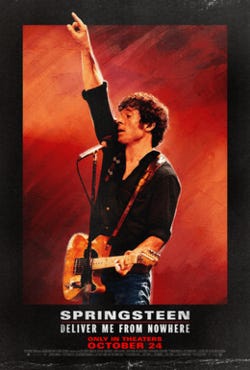
The image on the movie poster is the Bruce we know: guitar in hand, hand raised, band leader, crowd pleaser, rock and roll icon. The character in the film, though, moves heavily against this perception.
He is solitary, lonely, uncertain of his place in the world.
The film opens with Bruce completing the final show of the tour to support The River (1980). The crowd is roaring, the band in full glorious power rock. He walks off stage.
“Great show, Boss!”
He heads to the dressing room, alone. Where is the band? The contrast is immediate and dramatic. The crowd pleaser can’t please himself. He is drained, pushed back on his own resources, which are few.
He may be The Boss on stage, with the band, in the eyes of fans, the record company, the media, but what’s really going on is something else. This pulling back of the curtain is what Springsteen has spent the last decade unveiling. He isn’t who you think he is. Well, he is that — but he’s someone else, too. A man with chronic mental health challenges. He’s depressed, medicated, reliant on “professional help,” which is the plot point this movie leads to (not a secret reveal). The story of the movie isn’t where it goes to; it’s how it gets there.
As the movie opens, Bruce has just had his first top 10 hit (“Hungry Heart”): What next? Bigger and better!
Would you believe a solo album recorded in his bedroom on a four-track machine incapable of studio quality sound for which he would insist on no publicity, no tour, no singles? An album of stark, lonely, sometimes creepy songs featuring Bruce, harmonica, guitar, nothing else?
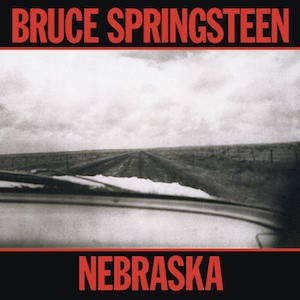
The album, of course, is Nebraska (1982), just re-released with additional material (2025).
Bruce came into my consciousness with the release of Born in the USA (1984), which spawned seven top 10 singles. I was 15. I believed the hype. The Boss with his 3+ hour live shows, working man ethos, truth teller, charismatic superstar. Also, maybe the fittest man in show business with his bulging biceps and hours-long fitness routine. A dude who made it, stayed grounded, had it all.
This is where a Bruce biopic might be expected to end — with the rock star achieving the summit. Dylan’s biopic, A Complete Unknown (2024), climaxes with the 1965 Newport Folk Festival with the folk star breaking into loud rock and blues rhythms. Get out of my way, here I come!
Deliver Me from Nowhere, however, is based on Warren Zanes’s Deliver Me From Nowhere: The Making of Bruce Springsteen’s Nebraska (2023). It moves against expectations, doesn’t launch the star into the heavens, and instead forces audiences to consider the recesses of Springsteen’s brain, his violence-filled childhood, his alcoholic father, and a darkness that has spread far beyond the edges of town.
In other words, it takes a world-dominating charismatic word-spitting protean artistic superstar and makes him nearly inarticulate and — small.
What’s going on here?
First, the movie relies on audiences already knowing the Bruce myth. He is huge, he is on a roll, he is unstoppable. If you didn’t, then the Bruce character’s trip into isolation wouldn’t seem nearly as strange as the filmmakers need you to believe. The film doesn’t set up the contrast between the two Bruces nearly enough. If you didn’t know Bruce, you wouldn’t know this Bruce.
Probably because, second, this depressed, isolated, darkness-filled storytelling Bruce isn’t such a surprise. He had previously released an album titled Darkness on the Edge of Town (1978), after all. Even Born to Run (1975), that ode to the open road, contains these lyrics: “this town rips the bones from your back/It’s a death trap, it’s a suicide rap,” “baby I’m just a scared and lonely rider,” and “everybody’s out on the run tonight but there’s no place left to hide/together, Wendy, we can live with the sadness.”
Everybody’s got a hungry heart, right? Everyone feels the pull of the dark.
But not everyone goes so deep down the rabbit hole.
It is perhaps interesting here to remember Kurt Vonnegut’s story diagrams, because what we’re considering here are plot curves. A Complete Unknown introduces the orphan (not really, but Zimmerman says he’s Dylan, educated at the circus and all of that, so orphan), who rises to fame, encounters headwinds, then overcomes the assholes and triumphs. Deliver Me from Nowhere introduces the superhero, The Boss — which he is called throughout the movie, but never earns the title; why would anyone take direction from this loser? — and immediately drops him into a pit of despair from which he only starts to emerge as the movie ends. The Bruce here is like Kafka’s protagonist in The Metamorphosis (1915), awakening to discover he’s a cockroach, a plotline Vonnegut gets to about the 7:00 minute mark.
Which brings me back to Springsteen’s self-demythologizing project.
He doesn’t want the cape; he wants us to know him, flesh, blood, and pharmaceuticals.
He’s not a working class hero, that was his dad.
The only job he’s ever had in his life was musician.
He may be The Boss, band leader, but he signed his record deal (1972) as a solo artist and entered the Rock and Roll Hall of Fame (1999) that way.
Which to me is the most curious thing.
Bruce is only The Boss if he has a band to lead, and I’d like to see the movie about that. For example, Clarence Clemons (1942-2011) was furious that Springsteen would enter the Rock Hall the way he did, without the E Street Band, who entered on their own (2014), but after Clemons’s death. Springsteen addresses this in Born to Run (2016), but the separation and reconciliation (or whatever) between The Boss and the Band of Brothers is the mini-series we all need.
Nebraska (1982) is part of that story. The band version of the album, Electric Nebraska (2025) has only just been released! The perfectionism that kept Springsteen focused on his bedroom recordings — and obsessed with “that sound” — also nearly caused him to toss the master tapes of Born to Run (1975) because he thought they weren’t good enough, were too …. well, something.
Artists, man. Lighten up? Hit the couch?
Or just power on?
Both.
I dig the self-conscious Bruce, don’t get me wrong. He’s done the work — reflecting on his life, his work, his purpose, his creative process, his choices, his path to sanity. His masculinity.
He’s provided a fantastic model for men to follow. Those who dare.
(And thank you to Springsteen’s manager, Jon Landau, for voicing “you need professional help,” and having the leverage, personal and professional, to make it happen.)
But is this quiet reflective depressive dude more real than the star-studded onstage marathon man?
He contains multitudes, surely.
*
A couple links to articles that expand on the context of Deliver Me from Nowhere and Nebraska, the album and the song, which was based on the film, Badlands (1973):
Bruce Springsteen’s Father Complicates a Powerful American Narrative, by Mitchell Duneier, New York Times, Nov 8, 2025
“Springsteen: Deliver Me from Nowhere”: Tamps Down the Boss, by Richard Brody, The New Yorker, Oct 23, 2025
Warren Zanes Interview (author of Deliver Me from Nowhere: The Making of Bruce Springsteen’s Nebraska), WTF Podcast #1436, May 18, 2023
Bruce Springsteen Interview, WTF Podcast #773, Jan 2, 2017
*